

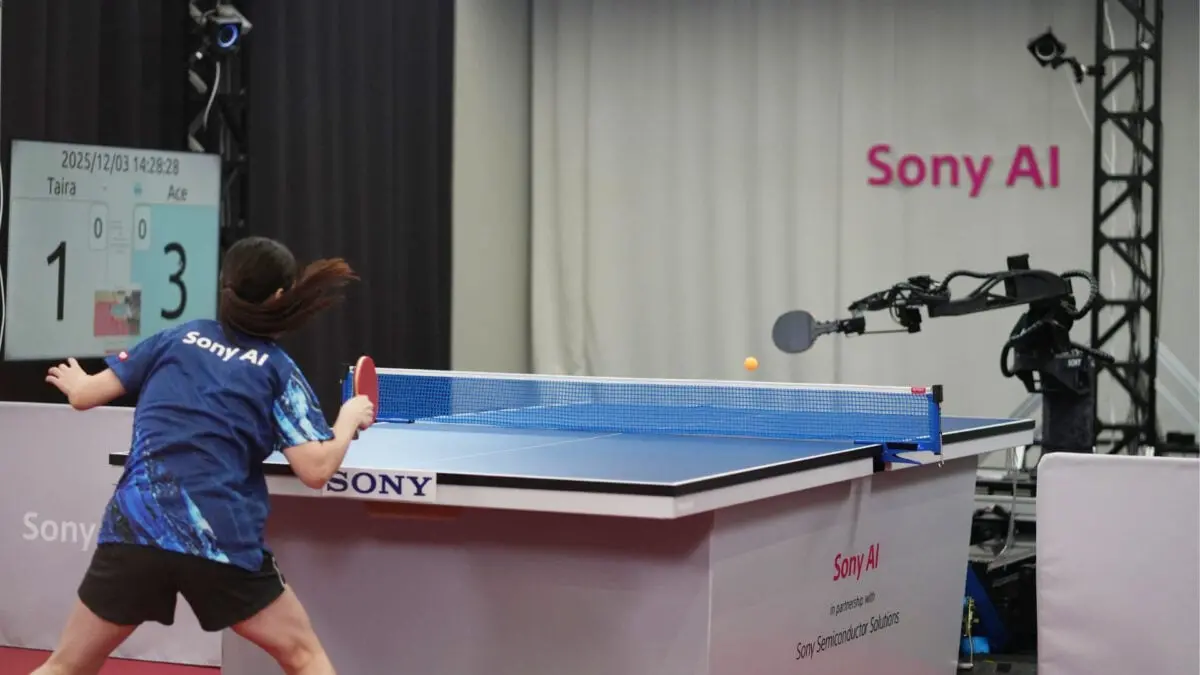
Watch out, there’s a new contender for the throne of table tennis champ—and it’s not human. Research out today showcases a robot that can match and even best elite human players. Scientists at Sony’s AI division developed the autonomous robotic system, dubbed Ace. Their study details how Ace won a majority of its matches against table tennis players with extensive experience, though it initially came up short against professional athletes. But in later matches, the robot defeated a top-25 world-ranked professional.
Ace’s Design and Technology
The Ace robot is a culmination of years of research into physical AI—systems that operate in the real world with perception, control, and agility. Unlike simulated environments where AI can rely on perfect information, real-world sports like table tennis demand rapid decision-making based on state estimation from noisy sensors and adversarial human interactions. Ace uses a combination of high-speed cameras, advanced motion planning, and machine learning models trained on thousands of rallies to predict ball trajectories and execute precise returns.
The robot’s hardware includes a customized robotic arm and a specialized paddle capable of generating high spin rates. The arm is lightweight yet powerful, allowing for quick adjustments mid-swing. The entire system processes visual data at over 1000 frames per second, enabling it to react to balls traveling at speeds exceeding 70 km/h. Sony AI researchers designed Ace to operate under the official rules of the International Table Tennis Federation (ITTF), with licensed umpires overseeing the matches—a first for robot-versus-human table tennis competitions.
Historical Context of Table Tennis Robots
Scientists have been tinkering with the possibility of tennis robots since the 1980s. Early attempts were limited by slow sensors and crude actuators, often failing to return even simple serves. In the 1990s, Japanese researchers developed prototypes that could rally with beginners, but they were far from competitive. The 2000s saw improvements in computer vision and robotic arms, yet no robot had ever won a regulation match against a human player with years of training. Ace represents a quantum leap, not only because of its winning record but also because it demonstrates the integration of AI learning and physical hardware in a real-time adversarial setting.
Study Results: Matches Against Elite and Pro Players
In the initial study, conducted in April 2025, the researchers paired Ace against five players deemed elite—defined as people with at least 10 years of playing experience who regularly trained 20 hours a week on average. The robot also faced off against Minami Ando and Kakeru Sone, two players active in Japan’s professional table tennis league. Ace won three of the five matches against elite players. It won one game against a pro, though it ultimately lost both matches to Ando and Sone. Throughout the matches, the robot displayed agile moves and could consistently serve and return high-speed and high-spin balls. The team’s findings were published in the journal Nature.
The experiments did not stop there. Ace had another set of matches in December 2025, where it was able to beat both elite and professional players—it won one of the two pro matches. In March 2026, the robot achieved a significant milestone: it won three matches against professionals, including Miyuu Kihara, who at the time was ranked in the top 25 of the World Table Tennis rankings for women’s singles. During these matches, Ace displayed improved performance at shooting balls faster and more aggressively closer to the table edge, according to lead author Peter Dürr. The robot’s ability to adapt its strategy over time, learning from previous matches, was a key factor in its progression.
Why Table Tennis Is a Benchmark for AI
Table tennis may seem like a niche sport, but it serves as an ideal benchmark for physical AI. The game requires fraction-of-a-second decisions, precise motor control, and the ability to read an opponent’s body language to anticipate shot placement. For a robot, this means solving problems in perception (tracking the ball and opponent), planning (choosing where to return the ball), and control (executing the swing with the right speed, spin, and angle)—all in less than 300 milliseconds. Success in table tennis indicates that similar technology could be applied to other fast-paced interactive tasks, such as surgical assistance, disaster response robots, or autonomous vehicles navigating crowded streets.
“Sony AI conducted this research to study how AI could operate safely and effectively in the physical world, where perception, control, and agility must come together in real time,” Dürr told reporters. “Unlike simulated environments where AI can rely on perfect information, real-world sports like table tennis demand rapid decision-making based on state estimation from noisy sensors and adversarial human interactions.”
Broader Applications Beyond the Table
The lessons learned from Ace might allow scientists to create better robotic systems for various applications across sports, entertainment, and other safety-critical physical domains. For instance, the robot’s ability to predict human movements could be used in collaborative manufacturing, where robots work alongside humans to assemble products. Its fast reaction time could inspire new prosthetic limbs that respond to neural signals in real time. Even in entertainment, Sony could develop interactive robotic opponents for other sports, making training more accessible for amateur athletes.
Furthermore, the software architecture behind Ace—which combines reinforcement learning with real-time sensor fusion—could be adapted for autonomous drones that need to navigate cluttered environments or for robotic assistants that help elderly people with daily tasks. The researchers emphasize that they designed Ace with safety in mind, ensuring that its movements are predictable and that it can stop instantaneously if a human steps into its path. This safety-first approach is critical for any robot that operates close to people.
Challenges and Future Improvements
Despite Ace’s successes, the robot still has weaknesses. It struggles with extremely slow, deceptive shots that disrupt its rhythm, and it can be overwhelmed by top professionals who employ a wide variety of spins and placements. The researchers acknowledge that Ace’s current design does not yet incorporate advanced tactical planning, such as setting up a sequence of shots to force an error. Future versions might integrate larger datasets from professional matches and use generative models to simulate more human-like strategies.
Additionally, the cost and complexity of Ace’s hardware limit its widespread use. The custom arm, sensors, and processing units are expensive, but as technology advances, similar systems could become more affordable. Sony has not announced any plans to commercialize Ace, but the research community is eager to see how these techniques evolve.
Reactions from the Table Tennis Community
Professional players who faced Ace had mixed reactions. Minami Ando, who defeated the robot in April 2025, noted that the robot’s speed was impressive but that it sometimes made predictable returns. After losing to Ace in December 2025, Ando acknowledged that the robot had improved its shot placement and spin variation. “It’s like playing against a very fast human who never gets tired,” she said. “The rallies are intense, but you can’t mind-game it because it doesn’t have emotions.”
Kakeru Sone, another professional who faced Ace, highlighted that the robot’s serve was particularly difficult to return because of the consistent spin. “Most humans have tells when serving, but Ace is perfectly consistent. You can’t read anything from its body language because it doesn’t have any,” he remarked. The researchers take these comments as validation of their approach, while also recognizing that human unpredictability remains a frontier for AI.
The study’s publication in Nature is a testament to the significance of this work. It places Ace alongside other AI milestones like AlphaGo and OpenAI’s Dota 2 bots, but with the added challenge of operating in the physical world. As Dürr put it, “We are still far from creating a robot that can beat the world’s number one player consistently, but Ace shows that the gap is closing faster than many expected.”
Source: Gizmodo News