

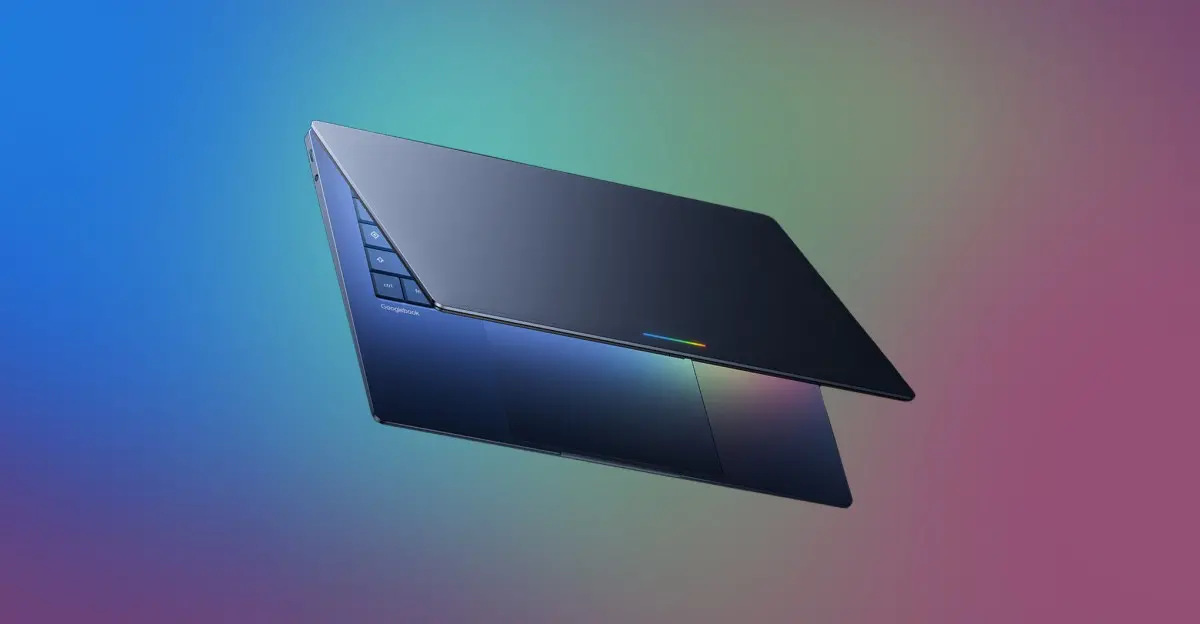
Google announced its new Googlebook laptop platform yesterday, and the reaction has been largely one of confusion. The company is effectively replacing the Chromebook and ChromeOS with something called the Googlebook, running a new operating system built on Android. But after the initial reveal, many are left asking: what problem is Google solving here?
For years, there has been speculation that Google would unify Android and ChromeOS under a single operating system, often referred to as Aluminium OS. The theory was that such a merger would turn Android phones into portable desktop environments, fix the messy state of Android tablets, and breathe new life into Chromebook laptops. Instead, Google unveiled the Googlebook: an awkwardly named laptop line with no concrete hardware specifications, a glowing light bar, and an OS that looks almost identical to ChromeOS. The only major difference seems to be deeper integration with Gemini, Google's AI assistant.
Chromebooks originally succeeded because they solved real problems. When they debuted nearly 15 years ago, they offered a lightweight, secure operating system that ran well on affordable hardware. They were perfect for education, where schools could issue each student a locked-down, virus-resistant laptop for a fraction of the cost of a Windows or Mac machine. The entire experience revolved around the Chrome browser, and for many people, that was enough. Chromebooks took over classrooms and made one-to-one computing a reality in countless schools.
But outside of education, ChromeOS has grown stale. Despite some excellent Chromebook hardware launches, the software hasn't evolved significantly. Meanwhile, the rest of the laptop market has surged ahead. Apple's M-series chips revolutionized performance and battery life, culminating in the MacBook Neo, which starts at around $600 and directly competes with Chromebooks. Windows on Arm has matured, offering fast processors and long battery life, while traditional x86 Windows laptops from Intel and AMD continue to improve. In 2026, $600 can buy a MacBook Neo or a very capable Windows laptop, leaving Chromebooks in a tough position.
The Googlebook appears to be Google's answer to this competitive pressure. But the answer is underwhelming. The new OS, built on Android, will certainly run Android apps better than ChromeOS did, but Android has always struggled as a desktop platform. Scaling mobile apps to a larger screen with keyboard and mouse input remains a compromise. Windows and macOS don't face this constraint; they are built for desktop computing from the ground up.
What about the AI features? Google emphasized that Gemini will be deeply integrated into the Googlebook experience, even allowing it to control the cursor. There are demos of AI-generated widgets, seamless file sharing with an Android phone, and image creation based on other pictures. But all of these features could have been added to ChromeOS without creating an entirely new platform. In fact, Chromebooks already added a Gemini key back in 2024. The Googlebook's Gemini integration looks like an evolution, not a revolution.
The lack of hardware details is also troubling. Google didn't reveal minimum specs, chip choices, or pricing. The only thing it showed was a glowing light bar on the lid, along with a separate acknowledgment that Intel would be one of the partners. Without concrete information, it's hard to know whether the Googlebook will be competitive on performance, battery life, or price. The MacBook Neo sets a high bar at $600, and Windows laptops offer a huge software ecosystem including gaming. What does the Googlebook offer to attract users?
It's worth considering the historical context. Google's previous attempts at hardware have been mixed. The Pixel line of phones has found a loyal audience, but the Pixelbook and Pixel Slate laptops were not commercial successes. The Chromebook Pixel was a premium product that never saw wide adoption. Google has a tendency to launch ambitious hardware projects and then abandon them after a few years. The Googlebook could face a similar fate if it doesn't gain traction quickly.
Furthermore, the operating system landscape is in flux. Apple's Liquid Glass design language has faced criticism for being buggy, and Microsoft's aggressive Copilot integration in Windows 11 has generated backlash. Google could have positioned the Googlebook as a simpler, more focused alternative, free from the bloat and AI hype of its competitors. But instead, the Googlebook doubles down on Gemini, making AI the centerpiece. Some commenters have already dubbed it the "Google Slopbook."
Given all this, the Googlebook feels like a solution in search of a problem. Chromebooks served a clear purpose: affordable, secure, browser-based computing for education and casual users. The Googlebook, with its Android core and Gemini obsession, doesn't seem to target any specific audience. Is it for students? Professionals? Developers? Google didn't say. Without a clear value proposition, the Googlebook risks being irrelevant before it even ships.
Of course, the product hasn't launched yet. Google promised more details later this year. But first impressions matter, and the initial reaction has been one of skepticism. Google needs to show, not just tell, what makes the Googlebook special. It needs to demonstrate real benefits over a MacBook Neo or a $600 Windows laptop. It needs to explain why customers should switch from Chromebooks or consider Googlebooks at all. Until then, the question remains: why does the Googlebook exist?
Source: The Verge News